humanizer
AIHumanizer.ai review: a long free rewrite that assumes cost savings
The Advanced guest rewrite retained most details but turned a neutral cost comparison into expected savings. The first saved output is much longer than the original.
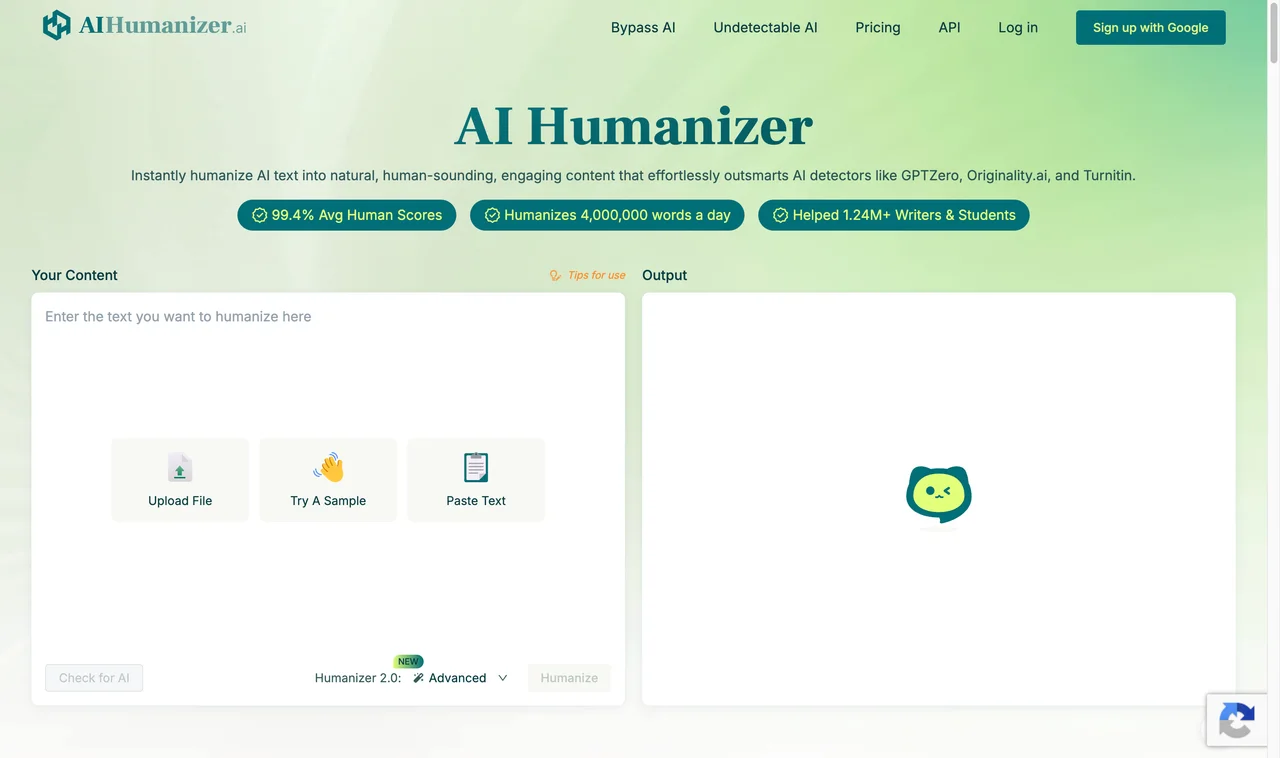
The screenshots, complete input and output, feature table and scoring breakdown are on the separate tool profile.
View AIHumanizer.ai tool details and evidenceAIHumanizer.ai completed our 93-word test in its free Advanced guest editor. The output kept the attendance figures, the trial's duration and most of its caveats. Its clearest factual problem came near the end: a neutral plan to compare costs became a plan to evaluate cost savings.
That change is easy to overlook because it sounds plausible. A library might hope to save money by changing its schedule. Our source did not say that savings existed or were expected. The rewrite introduced that favorable assumption while expanding the saved paragraph to 168 words by a whitespace count.
The AIHumanizer.ai tool profile provides the actual screenshots, complete source and output, feature table and dimension scores. This article examines the retained first output and the free-credit information we could verify on October 27, 2026. It does not treat the tool's detector labels as independent evidence of writing quality.
Getting a complete guest result
The shared benchmark is a short report about a library testing a four-day schedule. It contains fixed numbers, named weekdays, an unmeasured outcome and a conditional recommendation. We use it unchanged so each tool faces the same factual constraints.
The editor initially had a loading problem. After that was resolved, we submitted the full sample in Advanced mode and captured a complete result. Registration and payment were not required for this successful run.
We saved the first output before an accidental click started another generation. That later attempt is excluded. The profile's text, screenshots and scores all refer to the first captured result.
A later run might produce a different draft. We did not compare enough outputs to estimate how often the savings assumption occurs, so the criticism here applies to the saved paragraph rather than an inferred error rate.
The opening reframed the library schedule
The source describes a four-day schedule, not a specific employment arrangement for every staff member. The rewrite calls it a four-day work week. In context, the paragraph still concerns library opening hours, but that phrase can suggest a broader staffing policy than the original establishes.
The six-week duration remained intact. The output also kept the 40-hour weekly total and Wednesday closure, so the central operational facts were recognizable. It did not replace the total with a new number.
The sentence about extending Monday and Thursday hours was less direct than the source. The original explicitly identifies evening extensions. The rewrite's opening refers to added hours on those days, with the evening context appearing later in the paragraph.
That is recoverable from the full text, but it makes the reader assemble information that the source presented together. A concise factual rewrite would keep the day, time and unchanged weekly total in one clear account of the schedule.
The attendance figures were accurate
The original reports an increase from 1,200 to 1,320 visits a week. AIHumanizer.ai retained both numbers and the weekly basis. It did not reverse them, substitute a new total or add an unsupported percentage calculation.
The output also preserved the inconvenience for people who normally visited on Wednesday. They had to find other options after the closure. That is broadly consistent with the source's statement that those visitors needed to change their plans.
Those retained details give the reader enough information to follow the trial. They also make the local changes less conspicuous: an editor who checks only the visit totals could miss the new reference to a work week or the assumption about savings.
The expression about residents being forced to find other options is somewhat stronger than the original's neutral wording. It is not the most serious issue here, but it shows how a rewrite can make a report more dramatic while leaving its main event intact.
Productivity remained unmeasured
The source says staff reported fewer interruptions, but productivity was not measured. The output keeps that evidence boundary: employees experienced fewer interruptions, and their productivity during the trial was not evaluated.
That is preferable to treating the staff observation as proof that more work was completed. Fewer interruptions and measured productivity are related ideas, but they are not interchangeable findings. The returned text does not collapse them into one claim.
"The employees' productivity levels during the trial were not evaluated" is a longer way to say productivity was not measured. It keeps the limitation, but the added wording explains neither a method nor a result. We would retain the shorter source sentence in a concise report.
That is a useful distinction in this draft: some longer phrases remain accurate, while "cost savings" changes the claim. Cutting words is appropriate for the productivity sentence; the cost sentence needs a factual correction first.
The possible benefit was expanded at length
The source suggests that longer evenings may help people who work during the day. The output retains the idea of a possible benefit for people whose jobs prevent them from visiting during normal business hours.
That is close to the original meaning, but the explanation takes considerably more space. It replaces a familiar description of daytime workers with a longer account of individuals, jobs and access restrictions. The sentence is grammatical, yet cumbersome.
The rewrite also retains the warning against applying the result to every library. It does not present this local trial as evidence that all libraries need to reduce their opening days. That caution is a meaningful part of the original argument.
For this sample, the tool did more paraphrasing than simplifying. Readers who want a formal expansion may accept that tradeoff. Readers seeking a short, natural report would still need to cut the sentence back while keeping its conditional meaning.
Cost comparison became cost savings
The largest factual concern is in the closing plan. The team originally intended to survey residents, compare costs and repeat the trial in winter. The rewrite changed the cost task into evaluating savings associated with the new schedule.
A comparison can reveal higher costs, lower costs or no meaningful difference. Describing savings assumes a favorable direction before that comparison has happened. The source provides no result that supports the assumption.
This is not a minor synonym choice. It changes what the library appears to know about the trial and what the next stage of evaluation is meant to establish. A decision-maker reading only the rewrite might think savings were already part of the case for the change.
The correction is to restore neutral cost language. There is no need to add a counterclaim that the trial was expensive; that would be equally unsupported. The report should leave the question open until the planned comparison supplies evidence.
The winter repeat stayed uncertain
The output preserved the plan to run another trial during the winter months. It also retained the possibility that residents' travel patterns might vary in that season. It did not state that winter travel would definitely decrease.
That matters because the source gives a reason to repeat the experiment without predicting its outcome. The change in season could affect behavior, so the team wants more evidence before making the schedule permanent.
The timing of the permanent decision also remained. The follow-up checks are still presented as steps to take before committing to the new arrangement. The rewrite did not turn a temporary test into an already approved policy.
We would keep the survey and winter retest, then replace "evaluate cost savings associated with the new schedule" with the source's "compare costs". That one local repair leaves the follow-up plan open to an unfavorable as well as a favorable financial result.
Does the result sound more natural?
The draft is broadly grammatical and readable. It uses complete sentences, follows the source's sequence and does not insert a conversational assistant preamble. Those qualities make it easy to inspect as a standalone paragraph.
It is also much longer. The expansion comes mainly from formal substitutions and repeated framing rather than added evidence. Phrases about individuals whose jobs prevent visits take more space than the everyday wording they replace.
Length alone is not a quality failure. Some audiences need more explanation, and a rewrite can make implicit relationships clearer. Here, however, much of the extra text restates information that the source already expressed plainly.
We would not keep the output unchanged for a concise report. The useful editing task is to remove redundant phrasing, restore the neutral cost comparison and check that the opening does not imply an untested staffing policy. That is more work than accepting a polished surface suggests.
Change highlighting and selective editing
The workflow displayed a complete input and output, along with vendor detector-related information. We could compare the saved text with the source and preserve the result as evidence.
We did not verify a word-by-word insertion-and-deletion diff, a line-level change display or a completed selective sentence replacement. Those features therefore remain unverified in the profile rather than receiving positive tags based on assumptions about the interface.
Detector labels are a separate category. They do not show whether a number changed, whether a caveat disappeared or whether a cost comparison became a savings claim. Even an encouraging label would not resolve those factual questions.
For a document like this one, side-by-side reading is still necessary. Start with the numbers and schedule, then inspect uncertainty words and planned evaluations. The savings change demonstrates why the last step matters even when the numerical details are correct.
What the free allowance actually tells us
The public FAQ advertised 300 guest words and another 500 after registration. Our unchanged 93-word sample fit within the guest allowance and returned a complete result without creating an account.
That is evidence of usable free access for this short test. It does not prove an unlimited free plan, a recurring monthly allowance or a particular reset schedule. We did not exhaust the quota or test how retries are counted.
We also did not register merely to obtain the additional advertised credits. The task was to test the shared paragraph, and that had already succeeded. The extra registration allowance remains a vendor-listed feature rather than a separately exercised benefit.
Current paid allowances were not verified in this workflow. The profile says so directly instead of inventing a monthly comparison from incomplete material. If price is decisive, use the official checkout to confirm the term, word bank and per-input limits before buying.
API and automation remain unverified
An API menu was visible, but we did not establish a usable humanizer request contract from the material reviewed. A navigation label alone does not tell a developer how to authenticate, submit text, retrieve a result or handle errors.
For that reason, this product does not receive a verified API tag in our current directory. We also did not verify an official MCP server or agent skill. These are evidence limits, not a claim that the company could never provide such features.
No automated integration was run. We have no evidence that an API would use the same Advanced setting, consume the same credits or return the same kind of result. Those questions remain separate from the completed browser test.
For someone requiring programmatic access, this record leaves a concrete gap: we can show the browser result, but cannot point to a verified humanizer request and response contract. The menu label does not resolve that requirement.
Who should inspect this result closely?
A user looking for a free, account-free first draft can try the editor with a short sample. Our run shows that the full paragraph can be processed, and most concrete details survived. The profile provides the retained text so you can judge the style directly.
A user rewriting factual reports should pay particular attention to the ending. The cost-savings assumption is plausible enough to sound harmless, yet it changes the evidence. Similar edits in a longer document could be difficult to notice without the source nearby.
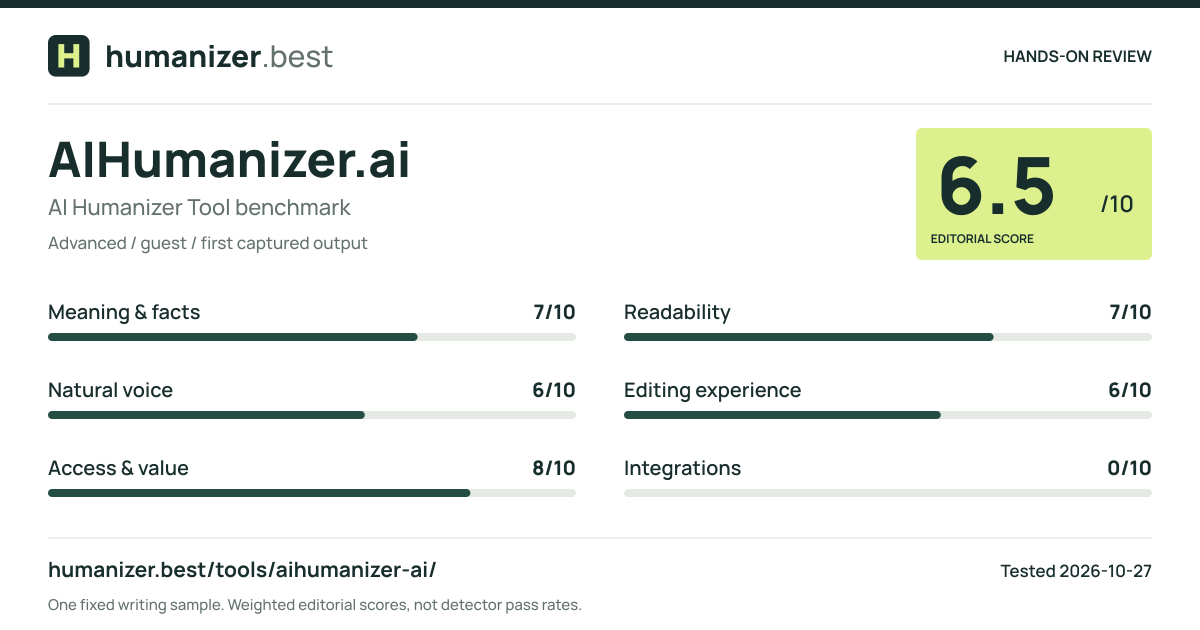
The resulting 6.5/10 score reflects useful free access and mostly preserved facts, offset by formal padding and the savings assumption. It is an editorial rating of this paragraph, not the detector percentage displayed by the vendor.
For this benchmark, the output is a draft that needs revision. Keeping the correct figures is a useful start; retaining the original uncertainty is just as important. Restoring the neutral cost comparison and cutting the formal padding would do more for this paragraph than relying on the interface's detector labels.
Sources and test scope
- Official Advanced editor, first output and free-credit FAQ · checked 2026-10-27
First captured Advanced output, saved before an accidental subsequent click. That later generation is excluded. Earlier editor-loading failure was resolved. Paid modes, independent detectors and live integrations were not tested.