humanizer
Voilà AI Humanizer review: a light edit that kept the facts
A restrained free rewrite preserved the numbers and qualifications. Good for a light neutral edit, with no verified word diff or dedicated humanizer integration.
The screenshots, complete input and output, feature table and scoring breakdown are on the separate tool profile.
View Voilà tool details and evidenceVoilà made very few changes to our test paragraph, and that was mostly a strength. Its free AI Humanizer kept the numbers, the schedule and the limits of the library experiment. It adjusted a few verb forms, added contractions and smoothed some punctuation. The result remained close to the original, without inventing an explanation or adding a chatty introduction.
The source was already readable, so there was little to gain from replacing every phrase. Voilà left us with a short set of edits to consider. A change-comparison view would have made those edits easier to inspect, but we did not find one in this workflow.
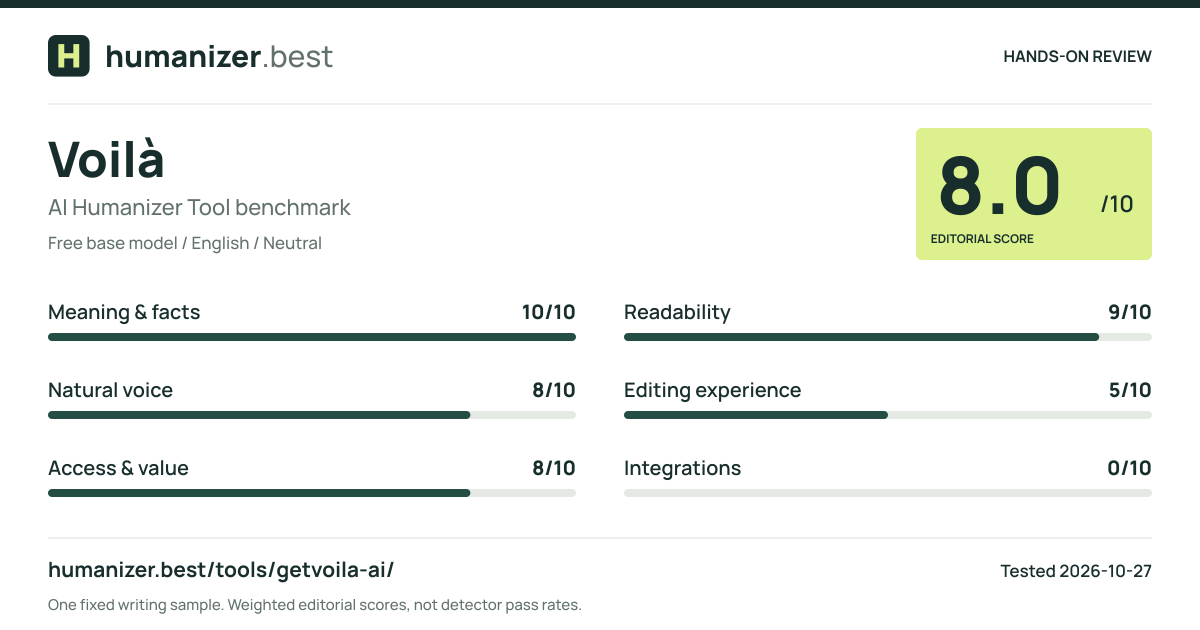
We tested the free browser workflow on October 27, 2026. The Voilà tool profile holds the homepage capture, input and output screenshots, full text comparison and score breakdown for that run.
The free workflow we actually used
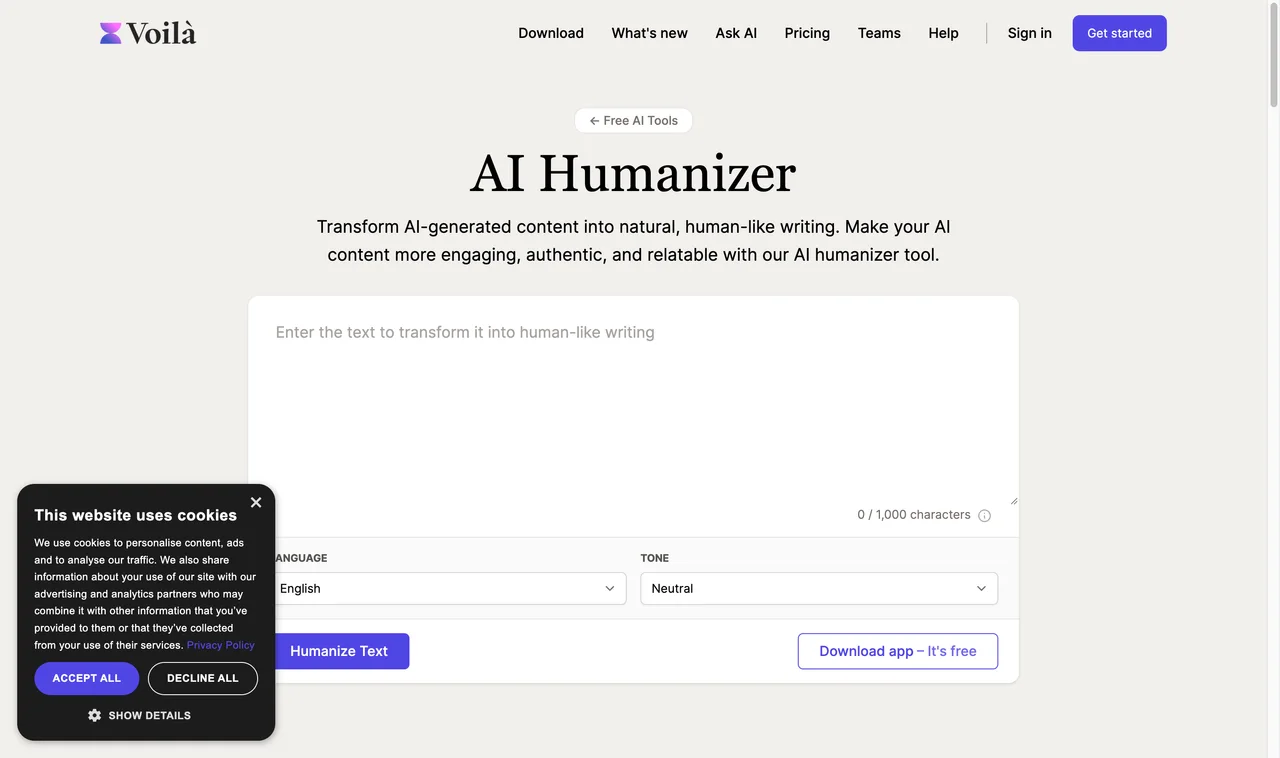
We opened the AI Humanizer page, pasted the full 93-word library passage and submitted it with English and Neutral selected. The page identified the available model as the base AI option and advertised advanced models as an upgrade. We did not select a paid model or create an account to complete this run.
The input limit shown in the editor was 1,000 characters. Our sample is 582 characters, so it fit without shortening or splitting. This matters for comparability: reducing a paragraph to fit a smaller free limit could remove exactly the sentence that causes another tool trouble. Every scored product receives the same complete input.
The output appeared as a finished paragraph with a Copy control. We saved that first result before any further generation. No retries were needed to find a version we liked, and no manual corrections were folded into the evidence. The small differences visible on the profile are the tool's own changes.
This was a low-friction browser task. It does not tell us how Voilà behaves with a large document, repeated requests, embedded tables or a different language. The convenience we observed was the ability to complete one short English rewrite without registration or payment. The Free and No signup tags describe that fact precisely.
Why this paragraph is a useful check
The benchmark describes a local library testing four opening days over six weeks while keeping its total weekly hours at 40. Wednesday closes, but Monday and Thursday evenings become longer. Attendance rises from 1,200 to 1,320 visits a week. Staff report fewer interruptions, though productivity is not measured.
Those statements are easy to paraphrase badly. A tool might treat four days as fewer total hours, call the attendance change proof that the schedule worked, or interpret fewer interruptions as increased efficiency. Each would make the writing sound more decisive while making it less faithful to the source.
The ending adds another set of checks. Longer evenings may help people with daytime jobs, but the passage does not recommend the same schedule for every library. The team intends to survey residents, compare costs and repeat the trial in winter. Seasonal travel habits may differ; the text does not say how they will differ.
Voilà kept those qualifications alongside the numbers. Its strongest contribution was avoiding extra interpretation: the report remained a description of a trial with further work planned, rather than becoming an endorsement of a four-day schedule.
The schedule survived without reinterpretation
The opening sentence remained unchanged. The next sentence kept the 40-hour total and the specific weekday adjustments, with small grammatical changes to the verbs describing closure and extended evenings. It did not turn the experiment into a reduction in weekly service hours.
That restraint is worth noticing. “Four-day schedule” can be confused with a four-day staff working week or a general reduction in operating time. Voilà left the context intact. A reader still understands that the experiment concerns when the library is open, with the same weekly total spread across fewer days.
The output also retained both attendance figures and the fact that they are weekly visits. It did not substitute rounded estimates, write out a wrong number or introduce a percentage calculation. Keeping the figures visible makes comparison with the source straightforward and avoids creating a new claim that would need checking.
The Wednesday inconvenience remained in the paragraph. People who normally visited that day still needed to adjust their plans. This prevents the rewrite from flattening the experiment into an unqualified success story. A community report should preserve both the attendance increase and the disruption to some existing visitors.
The evidence stayed separate from the interpretation
The staff sentence changed the wording around whether productivity was measured, but kept the limitation. Fewer interruptions remained a staff observation. The output did not state that employees completed more work or that the new schedule made them more productive.
This is one of the places where a humanizer can do harm without producing an obvious grammatical error. A sentence about improved efficiency would sound plausible in the story. It would still go beyond the information supplied. Voilà's result did not require us to reverse such an inference.
The proposed benefit for daytime workers also remained conditional. The output kept the possibility that longer evenings could help that group, rather than turning it into a demonstrated outcome. It retained the warning against assuming every library should open on fewer days.
At the end, the survey, cost comparison and winter repeat all survived. The uncertainty about travel habits remained uncertainty. The tool did not invent a seasonal pattern or replace a neutral cost comparison with an expectation of savings. These details are why the result scores strongly on meaning and facts.
Was it actually more natural?
The changes were modest. A few contractions made the paragraph slightly less formal, and small punctuation adjustments helped the list of follow-up actions read smoothly. The result stayed coherent and concise. We did not see broken grammar, abrupt fragments or unusual synonyms inserted merely to make the text different.
Whether it is better than the original is a narrower judgment. The source was already a plain explanatory paragraph. Voilà did not transform its voice, and we would not claim that the rewrite suddenly makes the text sound like a distinctive human author. It is closer to a light copy edit than a new composition.
That can be useful when the goal is to preserve a report while removing a little stiffness. It is less useful when the user wants a strong change in personality, a new structure or a particular publication's voice. Those would need a more specific brief and a separate test. Our Neutral setting did not ask for them.
The absence of an assistant preamble was another practical advantage. The output began with the library report itself, so there was no extra introductory sentence to strip out before copying. This does not guarantee that every result will behave the same way, but it made the captured example ready for a simpler final review.
Change highlighting and editing controls
The free result gave us a copyable rewritten paragraph. We did not observe a word-level insertion-and-deletion display or a separate line diff in the tested interface. A user still needs to compare source and result manually to see exactly what changed.
This matters even for a conservative rewrite. The fact that most words remain familiar can make a small factual alteration easier to overlook. A comparison view would help someone inspect the few changed phrases efficiently. Our profile therefore separates writing quality from editing experience rather than allowing a strong result to imply advanced review controls.
We also did not establish a sentence-specific rewrite feature in this workflow. A full-text action is not the same as selecting one sentence, receiving alternatives and applying one while preserving the rest. Nor does a Copy button demonstrate that the output can be edited directly in place.
For this sample, those limitations were manageable because the paragraph was short. For a longer document, the lack of a verified diff could become a larger cost in review time. We have not run that longer test, so this is a workflow consideration rather than a measured performance claim.
The free page and the wider subscription are different offers
The successful guest run is the clearest price finding: we paid nothing to process the full sample. The 1,000-character editor cap was visible. We did not establish an unlimited allowance for anonymous humanizer use, and the directory does not describe the free page as unlimited.
Voilà's official pricing page also describes its broader assistant subscription. It lists a Free offer with 250 requests, a Premium tier with 3,000 requests per month and an Ultimate tier with unlimited requests subject to the stated usage conditions. Those are suite-level plan descriptions, not a separately verified price list for the anonymous humanizer page.
The pricing view showed Premium at $10 per month under monthly billing and $8 per month under annual billing. Ultimate showed $20 and $16 respectively. An annual monthly equivalent should not be confused with the amount charged each month. We did not complete checkout or buy a subscription, so readers should verify the active billing selection and total before subscribing.
The page also describes a model fair-use threshold for the broader assistant, after which requests move to a smaller model. That distinction is relevant when comparing an “unlimited” suite with a simple word-based humanizer plan. Unlimited requests do not necessarily mean unlimited access to the same model under all conditions.
What the upgrade evidence does and does not show
The humanizer page promoted advanced models, but the base option produced the paragraph reviewed here. We did not run a paid comparison, so the upgrade's effect on writing quality is unknown.
A user considering the subscription should distinguish between wanting this particular rewrite and wanting the broader assistant. Voilà's pricing page lists other capabilities, including work with webpages and additional content types. Those may be valuable to someone who will use them, but they are outside this humanizer review's scored test.
For occasional short paragraphs, the guest workflow provides a way to inspect the output before committing. For heavier use, the request allowance, per-input limit and model policy need to fit the real workload. A comparison based only on the lowest displayed monthly figure would miss those differences.
We score access and value on the useful free result and the limits we could establish. We do not award points for every advertised suite feature or treat an upgrade banner as proof of a better humanization model. This keeps the value judgment tied to evidence a reader can inspect.
API, MCP and agent skills
We did not verify an official API, MCP server or downloadable agent skill for this specific AI Humanizer in the reviewed public material. The profile leaves those capabilities unconfirmed. That is different from asserting that no integration exists anywhere in Voilà's product range.
The pricing page mentions a bring-your-own-key option for the broader assistant. Supplying an external model key to a product is not the same as the product exposing its own humanizer API. The direction of the integration is different, and it would be misleading to use that mention as an API tag for this tool.
Likewise, browser-based access does not establish that an agent can call the same workflow through a documented interface. We did not install an extension, connect a client or run a programmatic rewrite. A developer comparing tools should look for an actual endpoint or tool definition, authentication requirements and billing rules before treating a product as automation-ready.
The integration score is zero because we could not verify that access, while meaning and facts earns 10/10 for the saved paragraph. Those scores describe different needs: a strong manual rewrite still leaves an automated workflow unresolved.
Our recommendation after the test
Voilà is worth trying when the task is a light, neutral edit of a short paragraph and preserving meaning matters more than changing every sentence. In this run, it kept the information intact and avoided the invented facts and awkward substitutions seen in several other outputs from the same benchmark.
The main limitation was the editing interface: we did not verify a detailed diff or selective sentence replacement. The subscription also covers a wider assistant, so its pricing should be evaluated against that broader use rather than assumed to be a dedicated humanizer allowance.
We would keep this as a candidate draft and decide which small edits suit the publication. The useful result was a free rewrite that preserved a carefully qualified paragraph. Detector bypass and plagiarism clearance were not tested and are not reasons for this recommendation.
Sources and test scope
- Official humanizer and tested controls · checked 2026-10-27
- Official suite plans and model fair-use policy · checked 2026-10-27
One short English sample and the first captured output in the stated mode. Paid models, long documents, external detectors and live integrations were not tested. Pricing is a dated snapshot; documentation is not an end-to-end integration test.