humanizer
GPT Humanizer review: when natural mistakes create extra editing
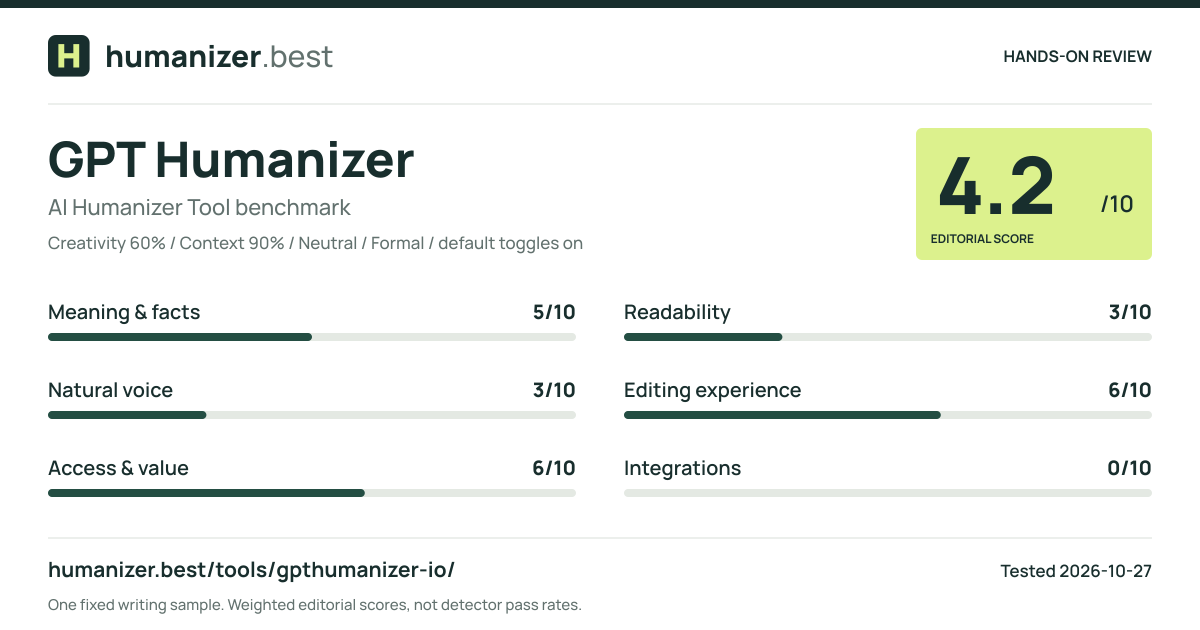
With Human Natural Mistakes enabled by default, the result changed local to topical and added punctuation problems. The transformation log was less reliable than reading the actual output.
The screenshots, complete input and output, feature table and scoring breakdown are on the separate tool profile.
View GPT Humanizer tool details and evidenceGPT Humanizer's default settings produced a draft that was harder to read than our original. The first word-level change turned a local library into a topical library. The result also inserted spaces before punctuation and left a sentence beginning with a lowercase letter. We would have to correct those defects before using the paragraph.
The interface had Human Natural Mistakes enabled. We kept that setting for the first result, so this review covers a configuration that explicitly allows mistakes. We did not compare it with the toggle off and cannot attribute each defect to that setting alone.
The GPT Humanizer tool profile contains the actual screenshots, source/output comparison, parameter table and scores from October 27, 2026. This article explains what happened in the free run and why the transformation log needs to be read alongside the actual text.
The settings we recorded
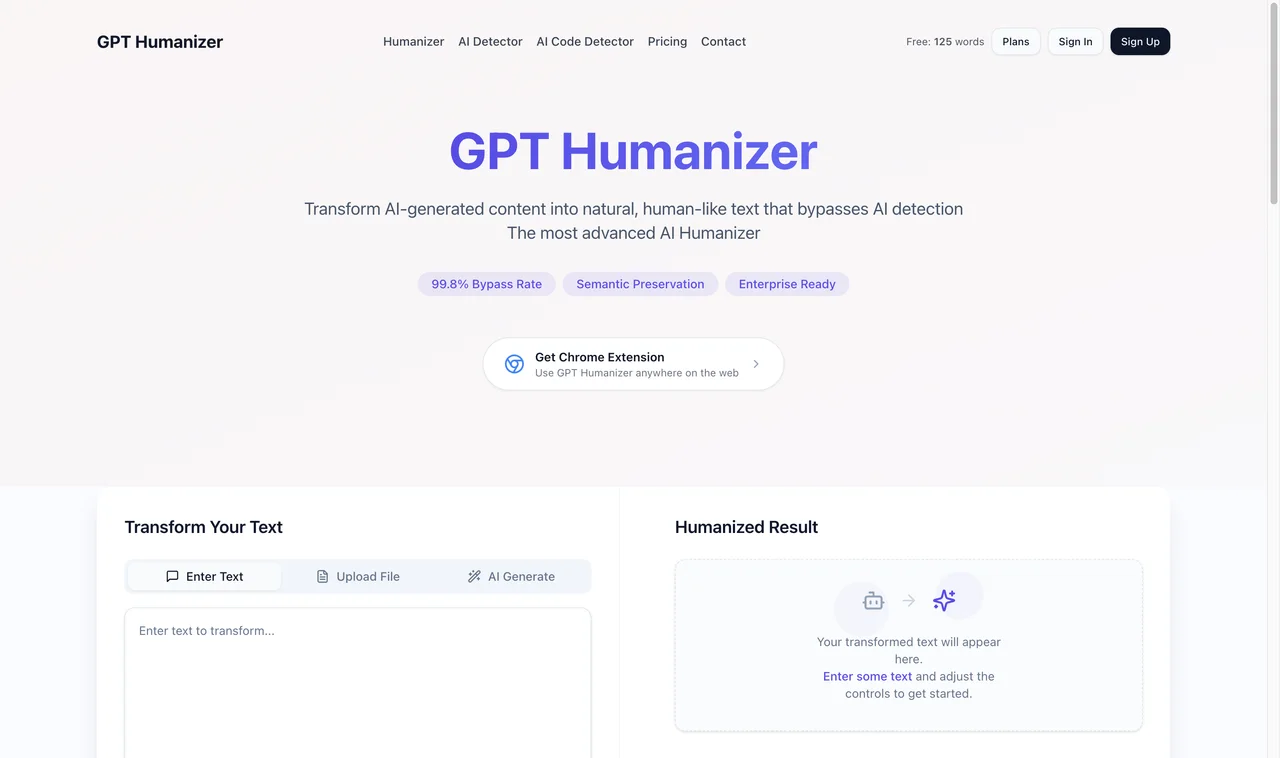
The editor showed Creativity at 60 percent and Context at 90 percent, with Neutral and Formal selected for the available style controls. Preserve Intent, Human Natural Mistakes and Save History were all enabled. We left those defaults unchanged for the comparable test.
The full 93-word paragraph fit the displayed free allowance of 125 words. After the run, the interface showed 32 remaining. We did not sign in, pay or trim the source. The complete result was available in the browser, so access itself was straightforward.
We kept the first completed output. Turning off a setting and generating a cleaner version might be a useful separate experiment, but it would not be the same test. The published evidence therefore includes the behavior of the default configuration, even where it was unattractive.
The selected controls should also be treated as product labels, not measured guarantees. A high Context setting did not establish that every factual relationship would remain unchanged. Preserve Intent did not prevent an incorrect synonym. The output provides the evidence for what those controls achieved in this run.
A local library became a topical library
The source opens with a local library. GPT Humanizer substituted “topical”, which does not describe the same thing. A local institution serves a place or community; topical normally concerns a subject or something currently relevant. The replacement is not a natural synonym in this sentence.
This is a small edit with a disproportionate effect. It appears in the opening words, so it immediately makes the report sound strange. It also changes a factual descriptor rather than merely adjusting rhythm or tone. A reader should not have to infer that the tool probably meant local.
"Topical" is especially distracting because the surrounding sentence otherwise closely follows the source. The reader has to decide whether the library has some unusual subject focus or whether the word is simply wrong. Nothing in the input supports the first reading.
We would restore local before using the draft. That correction is easy because the source is short and visible. In a long document, a similarly plausible-looking substitution could be much harder to notice, particularly if it affected a technical or specialized term rather than an everyday noun phrase.
Same hours became comparable hours
The original explicitly says the library kept the same 40 weekly opening hours. The rewrite changed that to comparable hours. Although the number 40 remained, comparable is weaker than identical and makes the sentence less precise.
The unchanged weekly total is central to the experiment. The library is testing a different distribution of hours across days, not simply reducing service time. Preserving the number while weakening the relationship can confuse the explanation of what actually changed.
This is another reason our fidelity check does not stop at counting matching numerals. A tool can retain every digit and still change the claim attached to them. Here, the exactness of the schedule matters as much as the presence of the number.
The rest of the schedule remained recognizable: a four-day trial over six weeks, Wednesday closure and extended Monday and Thursday evenings. The output was therefore not wholly inaccurate. Its weakness was a combination of mostly preserved content and a few needless changes that reduced clarity.
Punctuation became a cleanup task
Several sentences gained spaces before full stops or commas. A sentence about evening access also began with a lowercase word. These changes did not make the report more conversational; they made it look less carefully edited.
There is a difference between a natural voice and mechanical errors. Natural writing can use contractions, vary sentence length and choose concrete language while still respecting ordinary punctuation. Adding visible mistakes does not supply a personal perspective or a more suitable tone.
Whatever produced them, the visible mistakes created cleanup work the original did not need. The punctuation problems are easy to repair in 100 words, but repairing them would still leave "topical" and "comparable" to check against the source.
A user might choose to disable the toggle before a future run. We have not scored that alternative, and we would not claim that it solves the factual substitutions without testing it. The published result remains the first output from the recorded settings.
Much of the factual skeleton survived
Both attendance figures remained: visits increased from 1,200 to 1,320 a week. The inconvenience to Wednesday visitors was also retained. The output did not invent a different location beyond the incorrect descriptor, create a new attendance total or remove the visitor trade-off.
The staff sentence kept the distinction between fewer interruptions and unmeasured productivity. That was a useful piece of restraint. It did not convert a reported observation into proof that employees were completing more work.
The limited conclusion and planned follow-up largely survived too. The result still said the experiment did not prove that every library should open fewer days. The survey, cost comparison and winter repeat remained, with uncertainty about seasonal travel patterns.
These retained elements prevent a simplistic verdict that the tool changed everything. It did not. The problem is that the changes it did make were often less useful than leaving the source alone. A strong humanizer should improve or preserve a clear passage without adding defects merely to increase variation.
The transformation log was not a substitute for checking
GPT Humanizer displayed a Transformations Applied log. That is potentially helpful because it suggests an explanation of what the system changed. In our run, however, not every listed transformation matched the final text.
For example, the log described a change involving the written form of a number while the final paragraph still used the original form. We did not treat the log as a definitive account of the output. The actual returned prose is the authority for the comparison.
This distinction matters for any tool that presents a summary of its own editing. A generated explanation can be incomplete, imprecise or out of sync with the result. It should help direct attention, but it cannot replace a source/result check when factual accuracy matters.
The profile therefore publishes the full text rather than only a screenshot of the transformation summary. Readers can inspect what changed and what did not. We also avoid awarding a word-highlighting tag solely because a log lists proposed or claimed edits.
Editing controls and practical use
The browser workflow produced a complete output and offered a Copy action. The range of visible settings gave the user more control than a single unlabeled rewrite button. Those are useful aspects of the interface, even though the default result was weak.
We did not verify an inline word diff or a line-by-line insertion-and-deletion view. The transformation log is a different kind of aid. Without a reliable diff, a user needs to compare the source and output manually to catch the changed descriptor and weakened wording about hours.
We also did not establish a selective sentence replacement workflow. Regenerating the whole paragraph with different settings could alter parts that were already correct. For this captured draft, targeted manual repairs would be more predictable than assuming another full rewrite will preserve all the good details.
The smallest repair set would restore the factual terms, fix punctuation spacing and correct capitalization. That would bring the output closer to the original. It also raises a fair value question: if most useful content survived unchanged and the new changes require reversal, the humanizer has not saved much editorial work on this sample.
Free limits and the pricing language
The guest run worked without payment. The interface displayed a 125-word free allowance and then 32 remaining after the 93-word input. That observed balance is part of our evidence, separate from the pricing page's description of a per-transformation limit.
The official pricing page lists Free at zero cost with 125 words per transformation. Pro is shown at $9.99 per month and describes 30,000 words per transformation. Team is shown at $29.99 per month with unlimited transformation words and additional features, including advertised API access.
A per-transformation cap and a remaining word balance are different concepts. We did not establish when the guest balance resets or whether another request can use the same maximum again. The review therefore does not translate the free offer into an unlimited number of 125-word rewrites.
Likewise, we did not purchase Pro or Team to verify their practical limits. The table records the wording on the official plan page, including the billing unit it uses. That is more accurate than silently converting a per-transformation figure into a monthly word allowance.
API and other integrations
The Team plan advertises API access, but we did not verify a usable endpoint contract or authentication guide for the reviewed humanizer. No live API request was made. The feature is therefore described as advertised rather than assigned a verified API tag.
We also did not establish an official MCP server or downloadable agent skill. Those capabilities should not be inferred from the existence of a paid Team plan or the general idea of automation. They require identifiable documentation for the product itself.
An integration could make the tool easier to call from another application, but it would not change the quality of this result. A pipeline would still need to detect topical, comparable and the punctuation defects before publishing the text. Availability and fidelity are separate questions.
The Team plan's API claim therefore remains a purchasing question, not a working capability demonstrated here. Before paying for that purpose, a developer would need the request format and access terms that our review could not establish.
Our recommendation for this configuration
We would not use this default output without editing. The free access is convenient, and much of the source survived, but the incorrect synonym and deliberate-looking mistakes make the draft less polished than the original. The transformation log did not remove the need to inspect the actual paragraph.
Someone trying the tool should pay close attention to the Human Natural Mistakes setting and compare any alternative configuration against the same source. Our test does not establish that turning it off will solve every issue, only that the enabled default produced avoidable cleanup work here.
For this sample, we would keep the original unless a different configuration can show a clear improvement. The free result reduced precision and readability, despite its transformation log. Detector bypass, plagiarism and paid-plan performance were not tested.
Sources and test scope
- Official editor, settings and transformation log · checked 2026-10-27
- Official plan comparison · checked 2026-10-27
One short English sample and the first captured output in the stated mode. Paid models, long documents, external detectors and live integrations were not tested. Pricing is a dated snapshot; documentation is not an end-to-end integration test.