humanizer
Mask AI review: readable output that dropped the attendance evidence
The registered free trial returned clear prose but removed both attendance figures and the inconvenience to Wednesday visitors. The original and cropped editor capture show what disappeared.

The screenshots, complete input and output, feature table and scoring breakdown are on the separate tool profile.
View Mask AI tool details and evidenceMask AI returned a readable paragraph after we registered a free account, but the rewrite removed the attendance evidence. Both visit figures disappeared, along with the inconvenience to people who normally visited on Wednesdays. The result still sounded coherent, which is exactly why the omissions needed a direct comparison with the original.
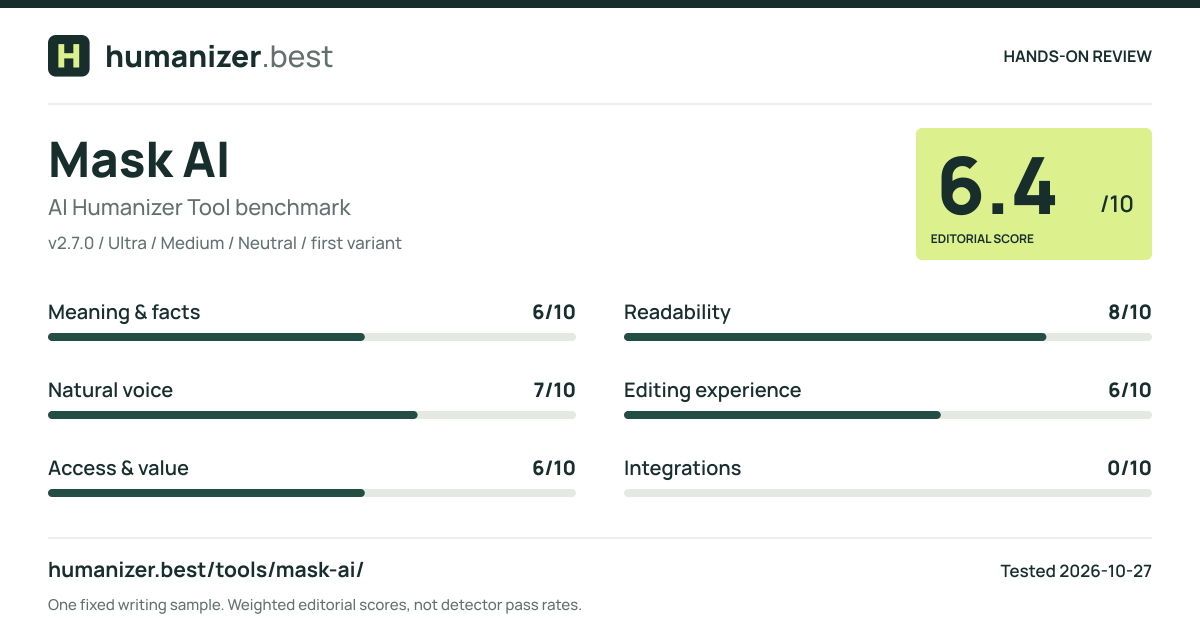
Our test used the first variant from the v2.7.0 Ultra workflow, with Medium intensity and Neutral tone, on October 27, 2026. The Mask AI tool profile contains the source and result, the editor screenshot, feature table and scoring. The screenshot is cropped to the editing area so it shows the actual test without publishing account details.
Registration and the free allowance
Unlike several tools that completed the sample anonymously, Mask AI required an account for our finished test. Registration succeeded, and the account displayed 300 free words. After the 93-word rewrite, the remaining balance was 207. We did not enter payment information or buy additional credits.
The balance fell by exactly the 93 words we submitted. That establishes how this run used the account allowance. It does not tell us whether another mode would consume words at the same rate or how a longer document would perform.
A later account view displayed a reset countdown. We have not converted that observation into a promise about every free account's renewal schedule. Free offers can differ from a promotional trial, and the public pricing page used a different allowance from the one we actually received.
The completed test earns Mask AI a Free tag, but not a No signup tag. Keeping those filters separate matters for someone who wants to try a paragraph quickly without creating another account. It also makes the directory's access claims reproducible: a free result can still involve registration.
The selected mode and the first variant
The editor showed model version v2.7.0, Ultra mode, Medium strength and a Neutral tone. We left those settings as displayed for the run. The result interface offered a variant carousel, but we preserved the first visible completed variant rather than browsing for a more favorable answer.
A reader can explore the carousel when choosing a draft for their own work. For this comparison, we used the first visible result, just as we did for the other tools. The omissions described here belong to that version.
The input area held the full shared paragraph. The screenshot shows the original on the left and the returned text on the right, allowing readers to check the comparison directly. We did not shorten the benchmark to fit an allowance or manually improve the output before recording it.
The interface language in the capture is Chinese, while both the input and output are English. That does not make this a translation test. The text task remained an English rewrite, and the selected neutral tone and medium intensity are recorded in the profile for clarity.
The schedule remained recognizable
Mask AI kept the four-day trial and the six-week duration. It also retained the same 40 weekly opening hours, Wednesday closure and longer Monday and Thursday evenings. Those details preserve the basic operational design of the experiment.
That is important because a shorter opening week does not necessarily mean fewer total opening hours. The source explicitly redistributes the hours, and the rewrite kept that distinction. A reader can still understand how the library tested fewer days without cutting its weekly total.
The staff observation and productivity limitation also survived. Fewer interruptions were reported, but productivity was not measured. Mask AI did not turn this into a claim that staff completed more work or that the schedule had proved more efficient.
These are substantive strengths. The output was not an unrelated summary, and it did not invent a location or a new attendance number. The problem was selective loss: some of the report's most concrete evidence disappeared while the remaining parts were expressed fluently.
The visit figures were gone
The original says weekly visits rose from 1,200 to 1,320. Mask AI's first result omitted both numbers and the attendance change itself. That removes a central observed outcome of the experiment, not an incidental detail.
Without those figures, the paragraph has less evidence for why the team might consider the new schedule. It still discusses possible benefits and future evaluation, but the reader no longer sees the measured change in use. The rewrite has shifted from a small report with data toward a more general description of a scheduling trial.
A human editor might deliberately remove figures from a very short summary. That was not our instruction, and the output was not constrained to a shorter length. A humanizer should not silently decide that the report's numerical evidence is expendable while keeping a similar amount of prose.
The omission is easy to miss because the result remains grammatical. There is no obviously broken sentence where the numbers used to be. This is why the fidelity score uses a checklist of source claims, rather than treating smooth prose as evidence that the information survived.
Wednesday visitors also disappeared
The source records that people who normally visited on Wednesdays had to change their plans. The result kept the closure but omitted the effect on those visitors. That removes the most explicit inconvenience associated with the trial.
The difference changes the balance of the report. A closure is an operational fact; its effect on existing visitors is a consequence. Keeping the first without the second does not fully preserve what the source says about the trade-off.
For a public-facing library update, that omission could matter to the audience. Residents want to understand both the potential benefits and the disruption. A rewrite that drops the inconvenience may sound more positive even if it never adds a promotional adjective.
We would restore the attendance sentence and its visitor qualification together. They belong to the same part of the source: an increase in total visits accompanied by a scheduling cost for some people. Replacing only the figures would still leave the report incomplete.
The ending was mostly retained, with a stronger prediction
Mask AI kept the proposed resident survey, cost comparison and repeat trial in winter. It also retained the general warning that one experiment does not establish that all libraries should reduce their opening days. Those qualifications prevent a more sweeping distortion.
The winter explanation became more confident. The source says travel habits may differ; the output says travel is likely to be different. That is a modest shift compared with the missing attendance evidence, but it still strengthens a possibility without new support.
The phrase "a resident's survey" also needs a small edit. It sounds like a survey belonging to one resident, whereas the source says the team will survey residents. "A survey of residents" would express that plan clearly.
The sentence about helping daytime workers was longer and less direct than the original. It did not reverse the beneficiary group, but the extra wording made a simple point harder to scan. We would simplify that sentence after restoring the omitted information.
The editing interface
The side-by-side editor was useful for this task. Keeping source and output in the same view made it possible to notice the missing numerical sentence without moving between tabs. Copy controls and the variant carousel were visible in the result area.
The interface also explained that selected text could be regenerated while leaving the rest unchanged. We recorded that affordance but did not complete a selective regeneration for the scored result. It would be misleading to present it as an end-to-end tested feature simply because a tooltip described it.
We did not establish a word-level insertion-and-deletion display or a separate line diff. A sentence-selection feature, even when available, answers a different question from change highlighting. One lets the user request an edit; the other helps the user inspect what has already changed.
For this particular output, manual comparison was enough to identify the problem. A longer document would need more systematic checking, especially if whole sentences can disappear without a visible deletion marker. We have not measured long-document behavior, so that remains a consideration for a future test rather than a claim about performance.
Why the public price page needs careful reading
The account allowance we observed was 300 free words. The public pricing page advertised a 600-word trial and showed a seven-day trial followed by a $131.88 annual charge. It also displayed $10.99 per month as an annual equivalent beside a higher monthly figure.
Those are different offers and should not be collapsed into one claim. Our account test demonstrates a free balance consumed by a short rewrite. The public trial page describes an offer with a renewal charge. We did not enter that paid trial or verify its checkout flow.
The paid toolkit is advertised as unlimited, subject to fair-use terms. We did not test those limits or buy a subscription. The free-account balance and this one completed rewrite are the practical access evidence we can offer.
A reader comparing prices should identify the exact offer being selected: free account allowance, a trial that renews, or a paid plan. The amount charged and the billing period matter more than the smallest monthly-looking number on the page. Our table preserves those distinctions rather than manufacturing one cost per rewrite.
API access is a separate product decision
An API link was visible in the editor. The account's developer page showed a prepaid credit offer: 250,000 words for a one-time $45 payment. We did not buy that pack or run an API request, and the available API balance remained unused.
The page also had a documentation control, but we did not obtain a usable endpoint contract from it in this session. We therefore record the API offering as observed, while leaving authentication details, request behavior and integration reliability unverified. The directory's verified API tag requires more than a menu label or a credit pack.
No MCP server or downloadable product-specific agent skill was verified in the reviewed material. A developer should not infer either from the presence of an API section. Each interface needs its own documentation and, for an end-to-end claim, an actual authorized test.
For this output, a programmatic workflow would need a check for missing facts before publication. The API offer does not resolve that problem: both attendance figures disappeared from the browser result despite the readable prose around them.
Our assessment
Mask AI made registration and the first free rewrite workable. The result was readable and preserved several important qualifications, including the lack of a productivity measurement. Its central weakness was omission: the attendance figures and the Wednesday visitors' inconvenience were removed without an obvious break in the prose.
That makes this output suitable only as a draft to compare with the source. We would restore the missing evidence, soften the winter prediction and fix the small grammatical issue before reusing it. We would not choose another carousel variant simply to make the published test look better.
The demonstrated benefit was access to a readable draft through a free account. The missing evidence prevents a stronger recommendation for this result. Paid-mode quality, detector bypass and API reliability remain untested; the recorded allowance should not be confused with the separate trial that renews into an annual subscription.
Sources and test scope
- Official product and account editor · checked 2026-10-27
- Public trial and subscription terms · checked 2026-10-27
- Account API credit page; documentation not verified · checked 2026-10-27
One short English sample and the first captured output in the stated mode. Paid models, long documents, external detectors and live integrations were not tested. Pricing is a dated snapshot; documentation is not an end-to-end integration test.