humanizer
NinjaChat AI Humanizer review: faithful prose with an extra preamble
The free rewrite retained the facts and caveats, but added assistant-style framing and conversational filler. The browser humanizer has no verified dedicated API or MCP interface.
The screenshots, complete input and output, feature table and scoring breakdown are on the separate tool profile.
View NinjaChat tool details and evidenceNinjaChat's free AI Humanizer kept the important facts in our library passage. It also returned something we would remove before publication: an assistant-style introduction announcing that it had revised the text. The actual rewrite was readable, conversational and longer than the original. That combination makes the tool useful for a first editing pass, provided you check where the finished copy begins.
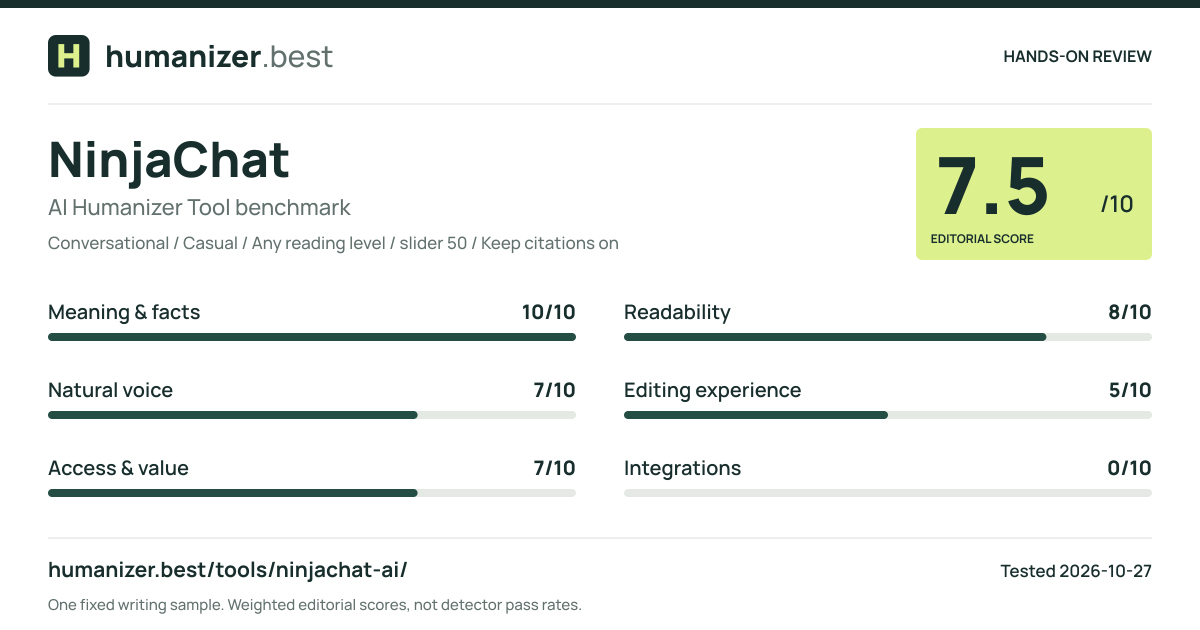
We tested the browser tool with our unchanged 93-word benchmark on October 27, 2026. No account or payment was required. The NinjaChat tool profile contains the input and result screenshots, complete text comparison, feature table and individual scores.
What we submitted and which settings we used
The sample describes a fictional library trying a four-day opening schedule for six weeks. Weekly opening hours remain at 40 because two evenings become longer. Attendance rises, but Wednesday visitors must rearrange their plans. Staff report fewer interruptions, while productivity remains unmeasured. The final sentence calls for a survey, cost comparison and a winter repeat before making the schedule permanent.
These details let us check more than grammatical polish. A rewrite can preserve every number and still overstate the evidence. It can replace a phrase with something that sounds fluent but changes who benefits. It can also delete a qualification to make a sentence shorter. Our benchmark deliberately gives the tool several chances to make those mistakes.
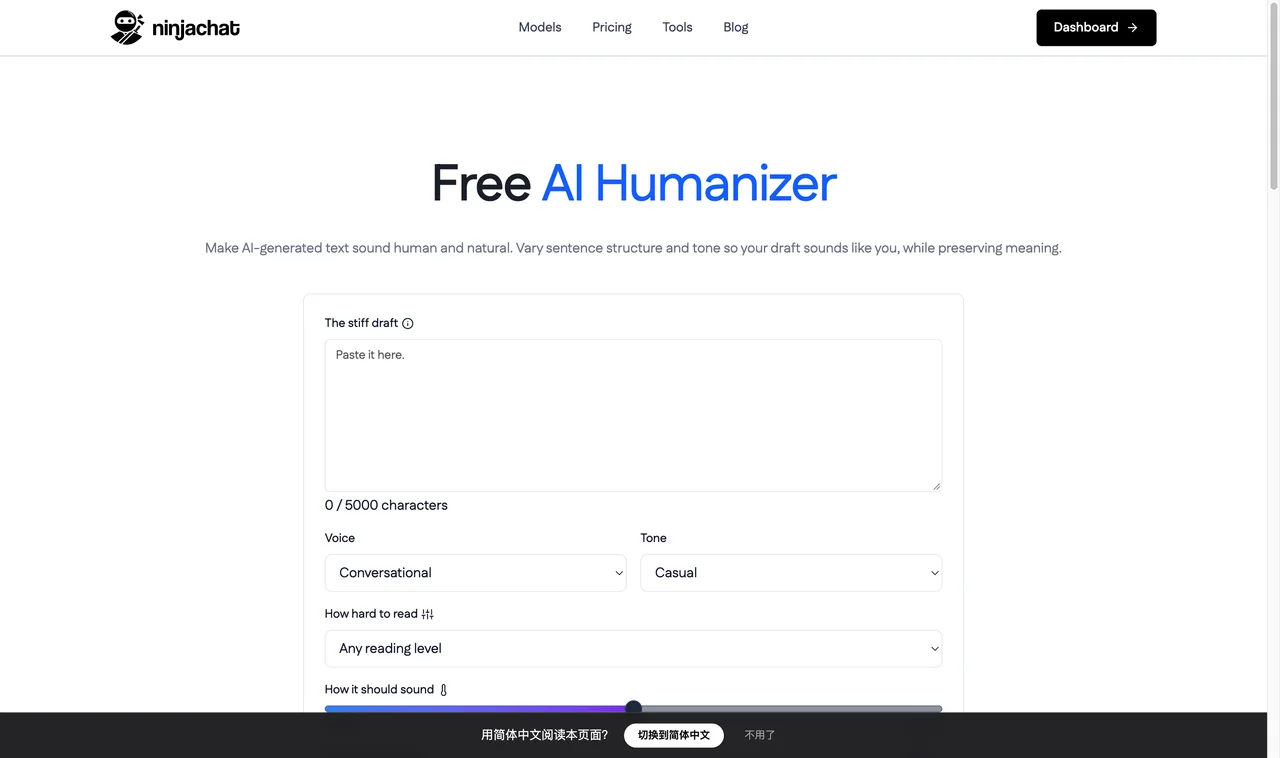
NinjaChat was set to Conversational style, Casual tone and Any reading level. The adjustment slider was at 50, and Keep citations was enabled. The passage contains no citations, so that last setting does not establish citation preservation. The editor displayed a 5,000-character limit, comfortably above the 582 characters in the sample. We used the first complete result and did not regenerate it to improve the review.
The comparison is specific to those settings. An academic tone, a different reading level or another slider position might produce different language. We have not scored those combinations. The default options were enough to establish whether this free workflow could handle the shared input and return a usable draft.
The first thing to remove is outside the paragraph
The result opened with: “Sure! Here's the revised version of the text following your specifications”. That is conversational assistant framing, not part of the library report. It should not be copied into a newsletter, an article or a briefing. Its presence also suggests that the output needs a final check even when the underlying rewrite looks competent.
This is a small cleanup task, but it matters in a tool whose purpose is to prepare prose for use elsewhere. Someone copying quickly could include the preamble. A batch workflow would need to distinguish that extra sentence from the requested content. We did not remove it from the published evidence: readers should see what the tool actually returned.
The introductory line says nothing false about the library, so it does not reduce the factual score. It does count against readability and voice: a writer asked for a rewritten report and received an announcement about rewriting it as well.
After the preamble, NinjaChat split the report into three paragraphs. The first covers opening hours and attendance, the second discusses staff observations and the limits of the conclusion, and the third covers follow-up work. That organization is sensible for a web page. It is less convenient if the destination calls for a single compact paragraph.
The facts held up better than the presentation
NinjaChat retained the six-week duration and the four-day schedule. It explicitly kept the 40-hour total, Wednesday closure and longer Monday and Thursday evenings. Those details work together: without them, a reader could wrongly conclude that the library simply cut its service hours. The rewrite did not make that mistake.
The attendance figures also survived. The output describes visits going from 1,200 to 1,320 during the trial. It does not say that the schedule proved the cause of that increase. That restraint is useful because the original supplies an observation, not a controlled explanation. The fact that two events occurred during the same period is not enough to establish why one changed.
Wednesday visitors still had to adjust their plans. This detail can disappear when a rewriting tool emphasizes only the apparent benefit of the experiment. Keeping it preserves the trade-off in the source. The result remains a report about a mixed operational change, rather than turning into promotional copy for a shorter opening week.
The staff sentence kept the distinction between interruptions and productivity. Fewer interruptions were reported; productivity was not tracked. A casual rewrite could easily turn that into a claim that staff worked more efficiently. NinjaChat did not. For this sample, that was one of the strongest parts of its performance.
The conclusion stayed appropriately limited
The source says longer evenings may help people who work during the day. NinjaChat writes "might be helpful for folks who work during the day". The possibility and the beneficiary group both survive; "folks" is a tone choice rather than a new factual claim.
The output also keeps the warning against applying the result to every library. It does not transform a local trial into general advice that all libraries should reduce their opening days. That qualification carries much of the meaning of the paragraph, and it remains visible rather than being buried in an added explanation.
The final paragraph retains the resident survey, cost review and another trial in winter. Travel habits "might be different", so the reason for another trial remains a possibility. NinjaChat does not invent a prediction about whether residents will travel more or less.
Taken together, these observations support a strong meaning-and-facts score for the captured result. They do not prove that NinjaChat always preserves factual details. We tested one short English passage, not a set of research papers, financial statements or multilingual documents. The evidence is narrow, but within that scope the rewrite was careful.
How natural did the rewrite sound?
The prose was easy to follow. Contractions and phrases such as “tried out” moved it toward the casual setting we selected. The sentences generally sounded like an explanatory update rather than a formal report. Readers who want that tone may prefer it to the more compressed original.
Some of the conversational treatment was unnecessary. The phrase “Of course” introduces the inconvenience to Wednesday visitors as though it were obvious to everyone. The source does not need that editorial aside. The word “folks” also brings a friendlier voice that may fit a community newsletter but would need adjustment for a neutral institutional report.
The Casual setting produced recognizable choices that an editor can accept or reject. "Tried out" fits an informal update; "Of course" adds an unnecessary attitude. We would decide on those phrases individually instead of assuming that a friendlier voice is always an improvement.
The rewrite expanded the passage. More words gave it room to separate ideas, but did not add new evidence. If the goal is a short notice, some of that expansion should be trimmed. If the goal is an accessible explanation on a website, the extra spacing and shorter conceptual sections may help. Our natural-voice score accounts for both the readable tone and the added conversational filler.
Editing controls and change visibility
The tested workflow offered a straightforward full-text rewrite and a Copy action. We also observed an output preview with a raw Markdown view. That can help when moving text between a web editor and a publishing system, although we did not test every possible formatting destination.
We did not observe a word-by-word change display in this run. The tool returned readable output, but the interface did not give us the same inserted-and-deleted-word view seen in The Prompt Index's Compare tab. That makes it harder to inspect small meaning changes without manually comparing the two versions.
A separate line or sentence diff was not established either. This distinction matters because paragraph breaks are not change highlighting. A result can look neatly organized while still making it difficult to identify precisely which source words disappeared. We therefore do not award NinjaChat a word-highlighting or line-highlighting tag based on the captured interface.
One-click rewriting and one-click correction are also different capabilities. The main action produced a complete alternative draft. We did not verify a control that selectively repairs one changed fact while leaving the rest untouched. For our result, the simplest final edit would be to remove the preamble, decide whether the casual asides fit, and preserve the remaining factual structure.
Free access and the pricing question
The full benchmark completed without signing in or paying. That is the basis for the Free and No signup tags on the profile. It does not establish unlimited use, unlimited input length or access to every NinjaChat model. The editor's visible character cap is a separate restriction from any account-level allowance.
NinjaChat also sells access to a broader AI platform. Its official pricing page advertised plans starting from $11 per month in the page title, but the plan table did not provide a complete stable set of allowances in the retrieved view. We have not treated that headline as a verified monthly billing offer for this specific humanizer.
Before buying, a user would need to check the active billing period, the amount charged at checkout, the included model or credit allowance, and whether the free Humanizer changes under that plan. Those details were not established by our successful guest run. The price comparison therefore records the free test clearly and leaves the paid humanizer terms unconfirmed.
We cannot turn the $11 headline into a cost per humanizer request. The paid allowance for this tool was not established, and the wider suite includes other services. The completed free run is the price finding a reader can use without those assumptions.
API, MCP and agent use
NinjaChat has official API and MCP material. The API page describes text, image, video and search capabilities. The MCP page focuses on a creative workflow involving images, video and voice. Those are real documented offerings of the broader platform, but they do not automatically establish an interface for the exact Humanizer we tested.
We did not verify a dedicated humanizer endpoint or MCP tool that reproduces this browser workflow and its settings. We also did not find a verified product-specific agent skill in the reviewed material. For that reason, the directory does not tag this humanizer as API- or MCP-enabled merely because NinjaChat offers those technologies elsewhere.
A developer could potentially build a rewriting workflow using a general text API. That would be a separate implementation, with its own prompt, model choice, costs and behavior. It should not inherit the score of this browser result. Our integration score measures the verified availability of the reviewed product's interface, not everything a developer might construct on the platform.
Who this result suits
For a short community update or an informal explanation, NinjaChat's free humanizer is a reasonable option to try. It preserved the details that mattered in our sample and returned prose that was easy to read. Its main weaknesses were the assistant preamble, extra length and absence of a verified change diff.
For tighter editorial work, keep the original beside the result. Check numbers first, then qualifications, then the audience implied by the tone. In this particular output, the factual pass was straightforward; the remaining work was mostly about removing framing and choosing how casual the final copy should sound.
For this paragraph, the cleanup is mostly editorial: delete the assistant introduction, decide whether to keep the casual asides and shorten it if the destination needs a single compact paragraph. The facts survived. Detector bypass, plagiarism clearance and long-document handling remain untested.
Sources and test scope
- Official humanizer and tested controls · checked 2026-10-27
- Official suite pricing · checked 2026-10-27
- General platform API · checked 2026-10-27
- General creative-platform MCP · checked 2026-10-27
One short English sample and the first captured output in the stated mode. Paid models, long documents, external detectors and live integrations were not tested. Pricing is a dated snapshot; documentation is not an end-to-end integration test.