humanizer
NoteGPT Humanizer review: readable expansion with a small certainty shift
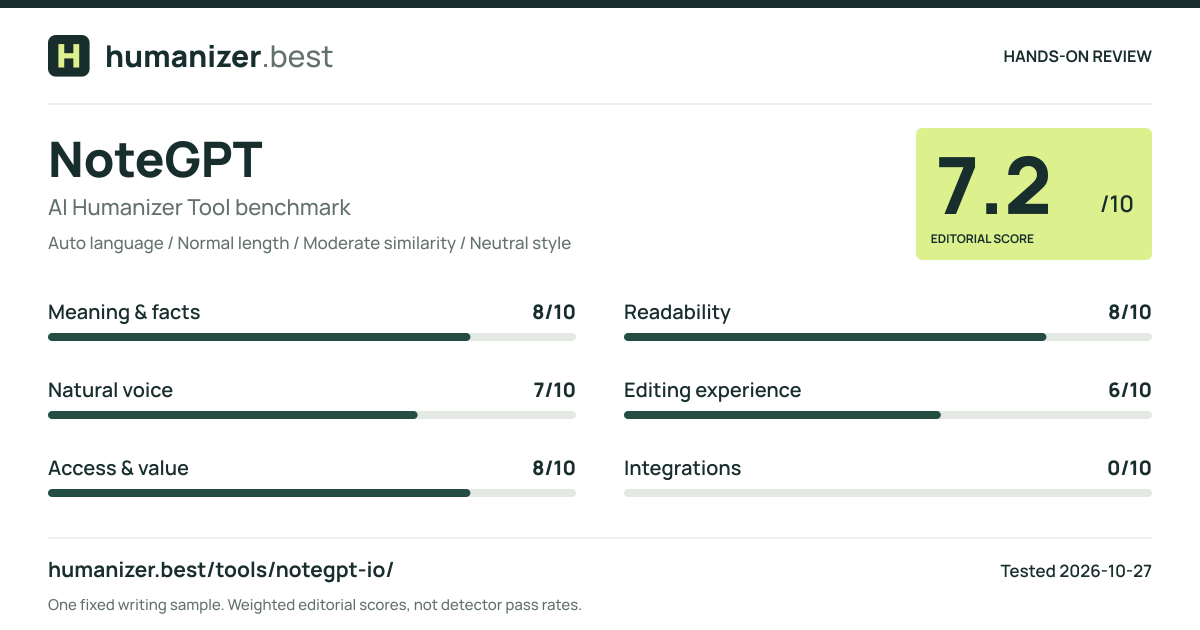
The free rewrite kept the key figures and qualifications, with more conversational phrasing and extra length. The possible evening-hours benefit became more confident.

The screenshots, complete input and output, feature table and scoring breakdown are on the separate tool profile.
View NoteGPT tool details and evidenceNoteGPT's free humanizer returned a readable, conversational version of our library report. It kept the schedule, attendance figures, staff limitation and planned follow-up. The main factual adjustment we would make is small but meaningful: the possible benefit of longer evenings became a more confident prediction.
The output also expanded the paragraph and added a few casual emphases. That may suit an explanatory web page better than a compact report. It does not make the result universally better than the source, and it does not establish anything about detector bypass.
We used the first complete guest result on October 27, 2026. The NoteGPT tool profile contains the actual screenshots, full text comparison, feature parameters and scores. This article explains the result and distinguishes the free humanizer from the wider NoteGPT subscription.
The workflow we tested
The search result led to NoteGPT's Undetectable AI page. We submitted the same 93-word, 582-character benchmark used across the comparison. The editor requested at least 300 characters and displayed a 20,000-character maximum, so the complete sample fit comfortably.
The selected options were Auto language, Normal length, Moderate similarity and Neutral style. We did not change them after seeing the output. The text remained English throughout, and the full result was available without signing in or paying.
The interface offered Download and Copy actions and a separate detector button. We saved the first rewrite without using a detector to judge it. The button shows another function is available; it supplies no detector result for this review.
We obtained the complete paragraph as a guest, so we could compare every source claim with the returned text. The score covers that saved result. It does not rely on a preview, a promotional example or a detector label.
The opening preserved the experiment
The rewrite kept a local library, a four-day schedule and a six-week trial. It retained the same 40 weekly hours, the Wednesday closure and later Monday and Thursday evenings. The basic design of the trial remained clear.
This is important because a shorter opening week can be misread as fewer total opening hours. The source explicitly avoids that interpretation, and NoteGPT did not introduce it. A reader can still see that the hours were redistributed rather than simply cut.
The language became a little more conversational, with the trial described in a less formal way. That change was supported by the source and did not require inventing background. The output did not assume a previous five- or six-day opening schedule.
The opening therefore worked well as a rewrite. It changed cadence while keeping the details that explain the experiment. Our score gives credit for that preservation rather than demanding that every sentence look maximally different from the input.
The attendance change stayed an observation
Both visit figures survived, increasing from 1,200 to 1,320 each week. The output added emphasis to the fact that visits rose, but did not directly claim that the schedule proved responsible for the increase.
That distinction matters. The source reports an observation during a trial, not a controlled causal finding. A rewrite can become less accurate if it turns the observation into proof, even when the numbers themselves are copied correctly.
The inconvenience to Wednesday visitors also remained. People who normally visited that day still had to adjust. Keeping that detail preserves the report's balance and prevents the attendance increase from becoming an unqualified success story.
We would remove "actually" from "Visits actually went up" in a neutral report. The word suggests surprise that the source never expresses. The figures and the visitor inconvenience can stand on their own without it.
The staff limitation was expressed plainly
NoteGPT retained the staff report of fewer interruptions and the fact that no one tracked whether more work was completed. That is a plain-language version of the source's statement that productivity was not measured.
The rewrite did not claim that staff became more efficient. It kept the difference between a perceived reduction in interruptions and an unmeasured productivity outcome. This was one of the important checks in the benchmark.
The wording is more casual than a technical report might use, but the idea remains understandable. A formal publication could restore the term productivity without changing the substance. A general audience may find the everyday wording easier to follow.
"No one tracked if they got more done" is direct enough for a casual explanation. For a formal account, we would keep "productivity was not measured" to avoid reducing productivity to the quantity of work alone. Neither version tells the reader that productivity improved.
The evening benefit became more likely
The source says longer evenings may help daytime workers. NoteGPT says they probably make visits easier for that group. The idea is plausible, but the probability judgment is stronger than the input supports.
May leaves a benefit open as a possibility. Probably suggests that the benefit is more likely than not. The benchmark does not provide evidence to choose that stronger level of confidence, so the rewrite should not make the choice on its own.
The difference is easy to overlook because the sentence sounds natural. A humanizer's most consequential changes are not always awkward or obviously wrong. Sometimes they are fluent adjustments to the certainty of a claim.
We would soften that sentence before publication. The group of people remains correct, and the proposed benefit remains relevant. The required repair is to restore the original caution rather than rewrite the whole paragraph.
The follow-up remained concrete
The result kept the resident feedback, cost comparison and another winter trial. It also preserved uncertainty about travel habits. Those details maintain the source's explanation that more information is needed before making a permanent decision.
NoteGPT added a reference to colder conditions in the winter explanation. That is ordinary context in many places, but it was not supplied in this fictional paragraph. We would remove the added condition when strict fidelity is the aim, especially because the library's location is unspecified.
The warning against applying the schedule to every library also remained. The output did not convert a local trial into a general recommendation to reduce opening days. Its conclusion was still appropriately limited overall.
These retained qualifications support a strong factual score, with a deduction for the certainty shift and added context. The score is not perfect simply because the paragraph is readable; the comparison asks whether each claim remains as cautious and specific as the source.
More conversational, and longer
The result contained 124 words according to the displayed output counter, compared with our 93-word source. Much of the expansion came from conversational phrasing rather than new useful information. The report was easier to hear as spoken explanation, but less compact.
That may be a good trade-off for a broad-audience web page. It may be a poor trade-off for a short notice, an executive summary or a paragraph with a fixed word budget. The selected Normal length option did not mean the output would match the source's length exactly.
We did not see a chat-style preamble announcing that the text had been rewritten. The result began with the report itself, which reduced the amount of material that had to be stripped out before reuse. There were also no conspicuous punctuation or capitalization defects in this run.
We would keep the plain explanation of the staff finding and shorten phrases such as "Before making anything permanent" where space is tight. The readable cadence earns credit, but "actually" and "probably" need separate decisions: one adds attitude, while the other strengthens the claim.
Copy, download and change inspection
The result interface made the complete draft available with Copy and Download controls. That supports a simple workflow of reviewing the text and moving it into another document. We did not test every export format or downstream editor.
We did not verify an inline insertion-and-deletion diff or a line-level comparison. The ability to read the source and result is useful, but it is not the same as highlighting each changed word. The directory therefore does not assign a word-highlighting tag from this run.
A selective sentence replacement workflow was not established either. We did not regenerate individual sentences, and we did not use the detector button to decide which parts to change. The first output remains the scored artifact.
For this short paragraph, manual inspection was enough to identify the stronger probability claim. Longer text would require more deliberate comparison, particularly if small certainty changes occur in several places. That is a review consideration rather than a measured claim about NoteGPT's long-document performance.
The free humanizer and the suite plans
The complete guest rewrite required no payment. The visible input cap was generous for this sample, but we did not establish an unlimited anonymous request allowance or its renewal schedule. The Free tag means the benchmark completed without payment, not that every usage pattern is free.
NoteGPT's pricing page describes a broader suite with basic quotas and premium credits. Those are different units covering multiple tools. A headline subscription price should not be treated as a dedicated humanizer price without reading which allowance applies to the rewriting workflow.
The annual view we retrieved showed Pro at $108 per year, displayed as $9 per month, with 1,000 basic quotas per month shared across tools including the humanizer. Unlimited showed $239 per year, displayed as $19.92 per month, and advertised unlimited basic humanizer quotas.
The same page showed a higher Max annual offer with more premium capacity. We did not buy any plan or verify how every basic quota translates into a particular humanizer request. The comparison records the published annual charges and keeps premium credits separate from the basic humanizer allowance.
Why the billing unit matters
A quota-based suite is not directly comparable with a service that sells a fixed monthly word bank unless the conversion is known. The amount of text per request, selected model and other tools used can affect the practical value of the subscription.
An annual monthly equivalent also differs from month-to-month billing. The smaller displayed number is useful for comparison only when the annual commitment is understood. We did not complete checkout, so the review does not claim a charged total beyond the public annual amount shown.
For someone who already needs the wider suite, the humanizer may be one part of the decision. For someone who only needs occasional rewriting, the completed free test may be more relevant. Our value score does not award every advertised suite feature as though it were tested here.
We did not compare a paid mode with this guest result. A larger quota would let a user process more text, but we have no evidence that it would remove "probably" or the added cold-weather explanation from the same paragraph.
API, MCP and agent skills
We did not verify an official API, MCP server or downloadable agent skill for this specific humanizer workflow. NoteGPT's broader AI Agent feature is not automatically an agent skill for rewriting, and it should not receive that directory tag merely because the names sound related.
A verified integration would need an identifiable interface, access requirements and behavior that can be tied to the product under review. No such humanizer integration was executed during this session.
For a developer, the missing piece is a supported way to submit text with the same Normal length, Moderate similarity and Neutral style settings. The browser run establishes those choices in the editor, not access to them from an external agent.
Manual users can still assess the complete rewrite on the profile. The unverified integration requirement matters separately for readers who need to run the same process across many documents.
Our recommendation
NoteGPT is worth a free trial for a short, conversational rewrite. The captured output preserved most of the source's details and limitations, with no major numerical error or invented baseline. We would soften the benefit claim, remove the added seasonal condition if strict fidelity is needed, and trim some extra wording.
The test does not establish detector bypass, plagiarism clearance, paid-plan quality or long-document reliability. It establishes a readable first guest result with a few specific edits still required. The linked profile supplies the full evidence so readers can judge whether that trade-off suits their own writing task.
Sources and test scope
- Official tested humanizer page · checked 2026-10-27
- Official suite pricing and quotas · checked 2026-10-27
One short English sample and the first captured output in the stated mode. Paid models, long documents, external detectors and live integrations were not tested. Pricing is a dated snapshot; documentation is not an end-to-end integration test.