humanizer
UnAIMyText review: easy access, facts to double-check
Free access is generous, but our Standard rewrite invented a location and changed the meaning of several claims. See the complete input, output and scoring.
The screenshots, complete input and output, feature table and scoring breakdown are on the separate tool profile.
View UnAIMyText tool details and evidenceWhat happened in the test
UnAIMyText made it easy to get a rewrite and hard to trust the result without checking it. We pasted the full library passage into the free Standard editor, left the tone on Casual and the language on English (US), then clicked Humanize. It returned a complete paragraph without asking us to register or pay. That is useful access for someone who wants to try a short draft before making a purchasing decision.
The output, however, introduced a location that the original never supplied. Our fictional library became “a municipal library in Melbourne.” The paragraph also drifted on productivity, the meaning of a shorter opening week, and winter travel. These changes matter more than whether the prose looks different. Someone reading the rewrite alone would have no way to know which details the tool invented.
This review concerns that first Standard result. An earlier 119-word passage was used to calibrate our test procedure; we then froze the shorter 93-word benchmark so tools with a 100-word free limit could participate. We reran UnAIMyText with the final input. We have kept the earlier pilot separate, and it does not contribute to the score shown here. The published result is the first complete output from the final benchmark, not a selection from several rewrites.
The facts that survived, and those that changed
Several details survived: the six-week trial, 40 weekly hours, Wednesday closure and increase from 1,200 to 1,320 visits. The draft also keeps Monday and Thursday as the days with added hours, though it drops the explicit reference to evenings. Wednesday users still need to change their plans. Much of the paragraph therefore remains familiar even where details have shifted.
Yet preserving the numbers is only part of preserving meaning. “It adopted the previous total weekly hours 40” is a clumsy way to say that opening hours stayed unchanged. The reader has to reconstruct the relationship between the number and the schedule. The original sentence was clearer.
The Melbourne addition is the most obvious factual failure. Our source says “a local library.” It gives no city, country or administrative status. “Municipal” could be a reasonable guess about many libraries, but it remains a guess. Melbourne is more serious: it turns an unspecified example into an apparently identifiable event. We would remove both additions before using this copy.
The productivity sentence needs closer attention. The source says staff reported fewer interruptions, “but productivity was not measured.” The rewrite says the hours “seem to be productive,” followed by a qualification that measurements were not taken. That inserts a positive productivity suggestion into a passage deliberately designed to avoid one. Adding a caveat after an unsupported suggestion does not restore the original meaning.
The conclusion also becomes less precise. “That doesn't mean a whole week needs to be cut” can suggest cutting out an entire week. The source is about opening on fewer days while maintaining the same weekly hours. A reader can probably infer the intended meaning, but an editor would still need to repair it.
Finally, “travel habits may differ” becomes “people tend to travel less.” The first statement leaves the direction of change open. The second asserts a tendency. The test passage contains no evidence for that tendency. This is a useful example of why fluent, ordinary-sounding additions still require scrutiny.
Does the rewrite sound more natural?
Some phrases are conversational. “Had to reschedule” is compact, and the paragraph does not bury the attendance figures under a long introduction. Its sentences vary in length. Those details earn some credit under natural voice.
Other choices make the text sound forced. “Shuttering on Wednesdays” feels heavier than “closing Wednesdays.” “The longer hours could work for workers” repeats the same root in a way that draws attention to the sentence instead of the point. “Before integrating the schedule” is less natural than the original wording about making the change permanent.
The output also expands the passage. By a simple whitespace count, our 93-word input became 119 words. A longer rewrite is not automatically worse, and we do not award points just for making text shorter. In this case, some extra length comes from invented detail or unnecessary phrasing. It does not consistently buy clarity.
Compare the individual claims with the source, especially the new location and winter prediction. The UnAIMyText tool profile contains the screenshots and both complete texts. Reading them together makes the additions easier to spot than reading the rewrite on its own.
We would not use this particular output as finished copy. A sensible revision would remove the city, restore the unchanged-hours sentence, retain the explicit lack of productivity measurement and put the winter sentence back into conditional language. At that point, much of the useful work comes from the editor checking the output.
The free editing experience
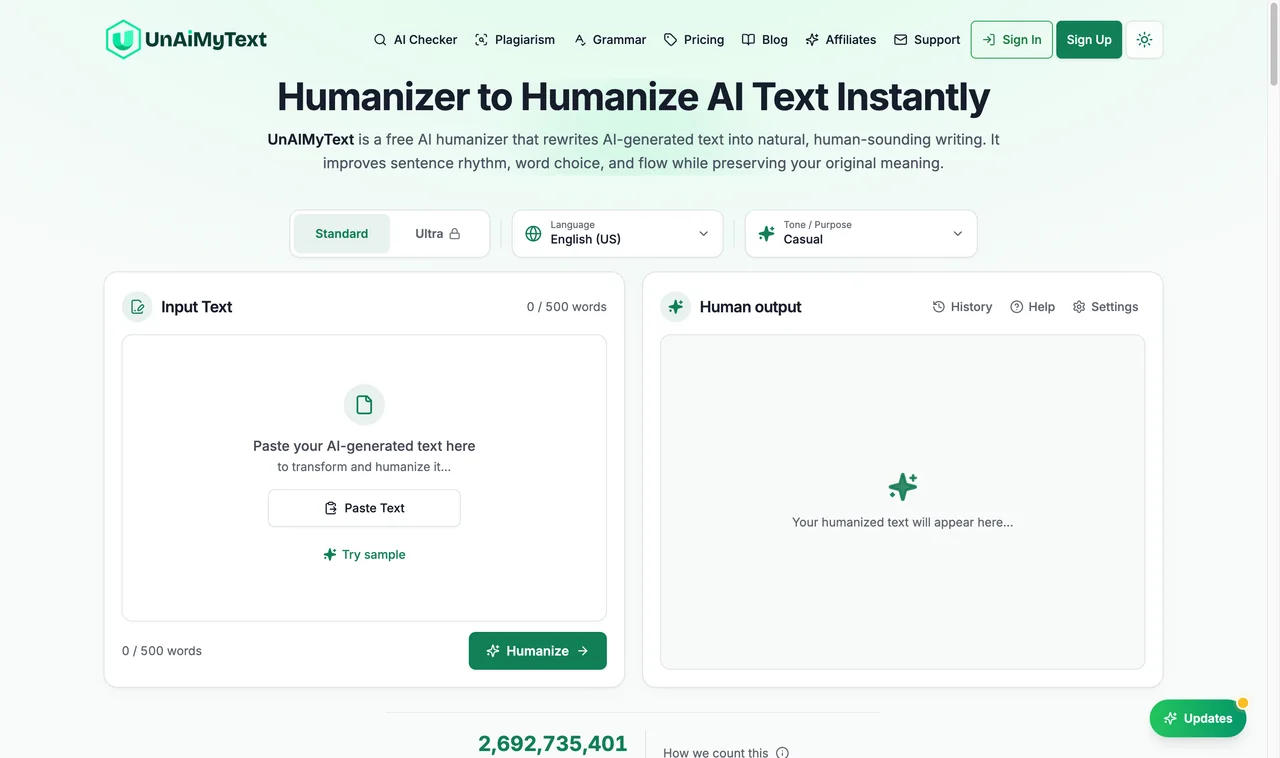
The basic workflow is straightforward. Input and output sit in the same editor. The input counter made the allowance visible, and the tool accepted our complete benchmark. The page offered Copy, Rehumanize, Check Plagiarism and Fix Grammar after generation. We observed those controls; the plagiarism and grammar features were outside this comparison and did not contribute independent quality evidence.
Rehumanize is convenient if you want another attempt, but we did not use another attempt to replace the scored result. A review that keeps generating until it finds a good paragraph would conceal the work a normal user might need to do. Our score concerns the first complete rewrite under the stated settings.
We did not see a word-by-word change display in the free result. The interface contains sentence elements, but that is different from a visual diff showing which words changed. We also did not establish a free sentence-rewrite workflow: the pricing information presents per-sentence rephrasing as a paid capability. That distinction matters if you want to improve one awkward line while retaining the rest.
The free workflow earns credit for returning a complete result without registration. Review assistance is more limited: the two text blocks are available, but we had to find the invented location and altered qualifications ourselves. A marked diff would help direct attention to those changes.
The language and tone controls are another useful part of the interface. We left them at English (US) and Casual. We did not run alternative tones, non-English text, document uploads or the Ultra model, so the result should not be read as a comparison of those options.
What free means, and what the paid plans cost
The pricing panel we checked separated visitors, free accounts and paid subscriptions. Visitor access was listed at $0, with Standard mode, up to 500 words per input and unlimited uses. A free account added saved history. Our completed test confirms that a visitor could obtain this short rewrite without payment; it does not independently establish that unlimited use would remain available under every traffic or abuse-control condition.
Basic was displayed at $9.99 per month, with 30,000 words per month and up to 1,000 words per input. The panel included sentence rephrasing in the paid offering. Pro showed a promotional $14.99 monthly price alongside $24.99, with 100,000 words per month, up to 2,000 words per input and access to Ultra. Prices and promotions are the panel's snapshot on the test date, rather than a promise about your checkout.
This is word-based subscription pricing. The monthly allowance and the per-input maximum answer different questions. A 30,000-word monthly allowance does not mean you can paste a 30,000-word document into one request. Likewise, a high per-input maximum does not remove the monthly cap. Check both numbers against the documents you actually work on.
For short experiments, the free visitor tier is substantial enough to assess the basic writing behavior. Paying mainly becomes relevant when you need the paid mode, longer individual inputs, more editing controls or account features. Our test does not establish that a subscription fixes the factual issues in the Standard output. We did not buy a plan or test Ultra, and we would not recommend an upgrade on the strength of an untested improvement claim.
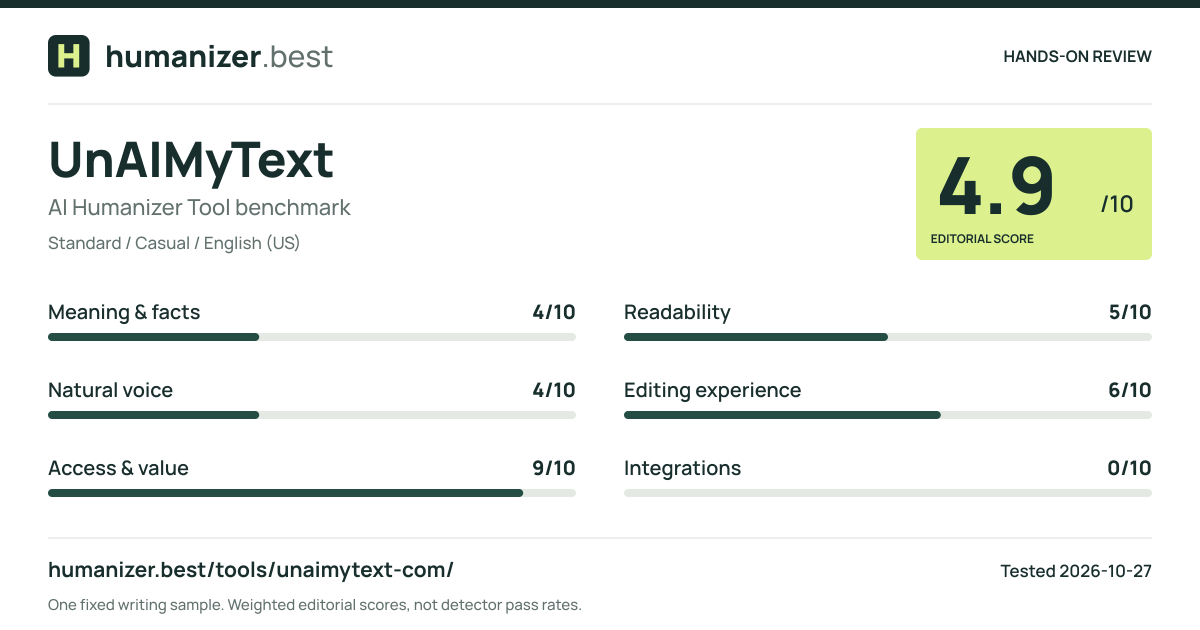
Free access earns 9/10 for value, while meaning and facts earns 4/10. Those scores explain the mixed verdict better than the 4.9/10 total alone: the visitor offer is generous, but the saved rewrite needs substantial factual repair. The profile shows the full breakdown.
API, MCP and agent skills
We reviewed the public homepage and its linked navigation for an identifiable official API, MCP server or agent skill. We did not locate documentation sufficient to verify those integrations in this review. Accordingly, UnAIMyText does not receive the API, MCP or Agent Skills filter tags on this site.
That is a statement about verified evidence, not proof that the company has no private integration or future development plan. We award integration points for an official capability readers can identify and investigate. A browser-only review does not become an API test merely because the website itself makes network requests.
For someone who wants to rewrite a paragraph manually, this may barely affect the purchasing decision. For an automated publishing workflow, it matters considerably. An integration needs usable documentation, authentication guidance and an understandable billing model. Until those are established, treat the tool as the web editor demonstrated here.
Why we did not use the displayed human score
The result panel displayed an 81% Human score for the Standard output. It also showed a higher prospective figure beside the Ultra upsell. Neither figure changes our assessment of the invented location or the altered claims. A score printed by the same product is not an independent test of those statements.
We did not send the result to Turnitin, GPTZero or another external detector in this session. We therefore make no claim about passing any of them. We also did not validate plagiarism clearance. Those would require separate procedures, and even a separate detector result would answer a different question from whether Melbourne appeared in the source.
The benchmark deliberately contains mundane facts and qualifications rather than an elaborate style challenge. That makes it useful for checking whether a humanizer respects its input. It cannot show how the product handles a research paper, a sales email, dialogue or a long document. The low fidelity score describes a real problem in this sample; it does not estimate how often that problem occurs across all possible inputs.
Who should try it?
UnAIMyText is easy to try when you have a short, non-sensitive draft and want to inspect a free alternative phrasing. Its lack of a registration barrier makes that experiment quick. Keep the original open and compare claims sentence by sentence, especially names, locations, quantities and statements about cause and effect.
We would be more cautious with copy in which an invented detail could mislead a reader. In our library sample, the most serious errors were not dramatic nonsense. They were plausible additions that could survive a casual proofread. That makes source comparison a necessary part of using this result.
The visitor offer makes UnAIMyText easy to test. This Standard result gives us little reason to replace the original, though: the main edits add repair work or unsupported detail. The downloadable sample is available if you want to compare a current result with the one preserved on the profile.
Sources and test scope
- Official editor, pricing panel and product navigation · checked 2026-10-27
One English passage, first Standard output. Ultra, paid sentence editing, external detectors, plagiarism checks and integrations were not tested. Screenshots reflect the test date. The 119-word pilot was excluded from scoring.